Sub-Zero Series · The 600 Family · 1996–2009
Sub-Zero 600 Series Repair: 1996–2009 Classics
If your kitchen was remodeled while the Jaguars were still new in town, odds are good a 600 series is anchoring it. We keep these classics cooling all over Mandarin.
Sub-Zero® built the 600 series from 1996 to 2009, and Mandarin's remodeled kitchens still hold plenty of 632s, 650s, and 661s. Most failures trace to control boards, thermistors, or evaporator fan motors — all still repairable — and typical tickets run $250 to $1,100 before sealed-system work enters the picture.
For Sub-Zero repair in Mandarin and along the Scott Mill riverfront, call Mandarin Sub-Zero Repair at (904) 892-7163 or book online .
Service notes current as of June 13, 2026
Which models make up the 600 family?
Owners of these units across Mandarin and Beauclerc — 32223 and 32257 — keep Mandarin Sub-Zero Repair on speed dial at (904) 892-7163, and the online booking page works just as well after hours. First step in any conversation is pinning down which 600 you have:
| Model | Configuration | Built |
|---|---|---|
| 601R / 601F | All-refrigerator / all-freezer columns | 1996–2009 |
| 611 | Over-under refrigerator | 1996–2008 |
| 632 | 48″ side-by-side | 1996–2008 |
| 642 | 42″ side-by-side | 1996–2008 |
| 650 | 36″ over-under | 1996–2008 |
| 661 | 36″ bottom-drawer freezer | 2003–2008 |
| 690 | 48″ side-by-side with dispenser | 1996–2004 |
| 685 / 695 | Later 48″ variants | 2004–2008 |
One wrinkle that matters more than the model number: the line spans three electronic generations. Units with serials below 1810000 are the original 600-1 electronics; the 600-2 and 600-3 generations followed with different boards and sensors. Add dozens of running part revisions and you get the rule we repeat to every caller — a part that fits a 632 will not necessarily fit a 650 or a 661, so we verify the revision off your serial tag before anything gets ordered.
What fails on a 600 series after twenty years?
Control boards and the famous double dashes
The EEPROM chip on the control board holds the unit's memory, and when it corrupts, the display gives up and shows "--" instead of a temperature. The cure is a replacement or professionally rebuilt board. Some part numbers have gone scarce and exist only as rebuilt exchanges now, which is exactly why these units belong with a shop that handles them weekly.
The vacuum condenser warning
Boards built between 1998 and 2002 track compressor run time and flash a "vacuum condenser" message when the unit runs too long — their polite way of saying the coil is suffocating under dust. Under Mandarin's oak canopy, where garages and kitchens collect more airborne debris than the spec writers ever imagined, we recommend a coil cleaning every six months rather than waiting for the light. It is the older dialect of the same warning a BI shows as an EC 50 or EC 40 code.
Thermistors and the service light
Temperature sensors drift with age, and a drifting thermistor triggers the service light or quietly skews the cooling. Cheap part, quick swap — the same sensor logic we walk through on our refrigerator repair service page.
Evaporator fan motors
The signature 600 pattern: freezer freezing happily, refrigerator drifting warm. The fan that lifts cold air to the fresh-food side wears its bearings out, often announcing itself with a drone or chirp first — sounds we translate on the noisy-unit diagnosis page.
Ice maker fill faults
The 600's logic flags a fault when the fill solenoid stays energized beyond 15 seconds, which on Jacksonville's mineral-heavy water usually means scale is holding the valve open. That repair belongs to our hard-water ice maker service.
A quick reference for 600 owners
| Display or behavior | Usual culprit on a 600 | What the fix runs |
|---|---|---|
| "--" where the temperature belongs | Corrupted EEPROM on the control board | $550–$1,100 |
| "Vacuum condenser" message | Dust-choked condenser driving long run times | $250–$550 |
| Service light, temps look off | Drifted thermistor | $250–$550 |
| Freezer cold, fridge side warm | Evaporator fan motor | $250–$550 |
| Compressor never shuts off | Coil, charge, or compressor wear — diagnosis decides | $250–$2,000 by cause |
Failure patterns by configuration
The 600 line shared a control platform, but the layout of each model decides where it tends to fail. Knowing the quirk of your configuration narrows the diagnosis before we arrive.
| Model group | Layout | What tends to go first |
|---|---|---|
| 650, 611 | 36″ over-under | Evaporator fan motor — the warm-fridge, cold-freezer classic |
| 632, 642 | 48″ / 42″ side-by-side | Independent air paths; freezer-side defrost faults and door seals |
| 661 | 36″ bottom-drawer freezer | Drawer slide wear and gasket leaks letting humid air in |
| 690, 685, 695 | 48″ side-by-side, often with dispenser | Dispenser valves and hard-water scale at the ice and water path |
| 601R / 601F | All-refrigerator / all-freezer columns | Single-circuit sealed-system and thermistor faults |
The dispenser-equipped 690 deserves a special note in Mandarin: its through-door water and ice path runs the same 14-to-28-grain supply that scales every other ice maker here, so it lands on our hard-water ice maker bench more than the non-dispenser models do.
Why part revisions matter more than the model number
The single most useful thing to understand about a 600 series is that "632" is not one part list. Across the 1996–2009 run the line moved through three electronic generations and dozens of running changes, so two 632s built five years apart can need different boards, sensors, and even ice maker components.
- 600-1 — serials below 1810000, the original electronics; some boards now exist only as rebuilt exchanges.
- 600-2 — the middle generation, with revised board logic and sensor specs.
- 600-3 — the final electronics, generally the easiest to source parts for.
This is why we ask for the serial before ordering anything: matching a 600-2 board to a 600-1 cabinet, or pulling a 650 fan for a 661, is exactly how a repair turns into a return trip. A shop that handles these weekly keeps the revision map in its head — a generalist who sees one a year does not. The same revision discipline carries forward to the line that replaced it, which we cover on the BI built-in service page.
The repair-versus-replace math, worked out
Owners ask whether a twenty-five-year-old unit is throwing good money after bad. For a 600 in custom Mandarin cabinetry, the arithmetic almost always favors the repair — here is a concrete example rather than a slogan.
| Path | What it costs | What you get |
|---|---|---|
| Replace the board on a 650 | $550–$1,100 | Another decade from a cabinet built for 20-plus years |
| Replace the unit with a new built-in | Several thousand for the unit, plus cabinetry rework | A panel-ready fit that may not match the existing run |
| Sealed-system repair stacked on other failures | $1,500–$3,000 | The one case where replacement deserves a real look |
Several riverfront households along Beauclerc Road run two or three of these units plus wine storage, and keeping the fleet alive beats replacing it one custom cabinet at a time. When a sealed-system failure does stack on top of other aging parts, we lay out the numbers and let you decide with them in front of you.
Is a 600 series still worth repairing?
Around Mandarin, almost always. The houses between San Jose Boulevard and the river mostly date from the 1970s through the '90s, and the kitchens that got their big remodel in the late '90s and 2000s are exactly where these units live — often sized into custom cabinetry that would cost real money to rework for a modern replacement. A board at $550 to $1,100 against a five-figure built-in swap plus carpentry is not a close call.
Our rule of thumb, stated plainly: repair wins until a sealed-system failure stacks on top of other aging parts. Even then we quote the repair honestly — evaporator and refrigerant work runs $1,500 to $3,000 — and let you decide with the numbers in front of you. Several riverfront households along Beauclerc Road run two or three of these units plus wine storage, and keeping the fleet alive beats replacing it one cabinet at a time.
From the route: a 650 that confused its owners
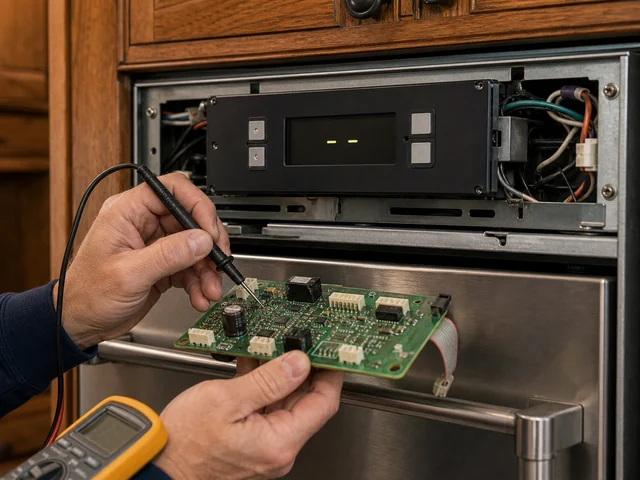
An educational diagnostic scenario, shared the way we would tell it over the fence. A Beauclerc kitchen, a 650 over-under from around 2001: milk going warm on the top shelf, freezer drawer frozen solid, display reading normal. The owners assumed compressor and braced for the worst. The actual finding — the evaporator fan had slowed to a crawl, so the cold stayed downstairs while the fresh-food side starved for airflow. One fan motor, one visit, and the twenty-year-old unit went back to work. The lesson we want every 600 owner to keep: "freezer fine, fridge warm" is usually the cheapest failure on the list, not the most expensive one.
Newer kitchen down the street with the same warm-shelf complaint? The causes shift with the generation — compare the BI series failure patterns to see how different fifteen years of design changes make the diagnosis.
600 series questions, answered straight
What do the double dashes on my 600 series display mean?
Two dashes where the temperature should be means the control board’s EEPROM — the little memory chip that stores the unit’s settings — has corrupted. The refrigerator often keeps cooling on default behavior, but the board no longer stores settings reliably and needs replacement or rebuilding. It is the single most recognizable 600 series failure, and it is fixable.
Are control boards still available for a 1998 Sub-Zero 632?
Some are, and some now exist only as rebuilt exchanges — a vendor refurbishes your original or a core unit rather than supplying new-old stock. The catch is revisions: the 600 line went through dozens of part changes, so a board that fits one 632 may not match another. We confirm the exact revision from your serial tag before ordering anything.
Is a 25-year-old Sub-Zero 650 worth repairing?
Usually, yes. These cabinets were built for a 20-year-plus service life and the common repairs — boards, thermistors, fan motors, gaskets — each cost a small fraction of replacing a built-in, which means new cabinetry work on top of the unit price. The honest exception is a refrigerant leak stacked on other failures; when the math stops favoring repair, we show you the math.
How do I tell which electronic generation my 600 series is?
Check the serial number on the tag inside the fresh-food compartment. Units before serial 1810000 are the first electronic generation, called 600-1, and later units fall into the 600-2 and 600-3 generations. The distinction matters because boards, sensors, and even some ice maker parts changed between generations — it is the first thing we ask when you call.
What is the vacuum condenser light actually asking me to do?
Exactly what it says: the boards installed from 1998 to 2002 watch compressor run time, and when it runs excessively they assume the condenser coil is choked with dust and ask you to vacuum it. Often a thorough coil cleaning clears the warning. If it returns with a clean coil, run time is high for another reason — a tired compressor or low charge — and that deserves a diagnosis.
My 632 side-by-side keeps an icy refrigerator section but a warm freezer — is that the same fan problem?
No, that is the reverse of the classic pattern and it points somewhere else. On a 632 each side has its own air path, so a warm freezer with a cold fridge usually means the freezer evaporator fan, a defrost fault icing that coil, or a door seal letting warm air into the freezer side. The famous 600 fan failure is the opposite picture — warm fridge, cold freezer. We confirm which compartment is starving for airflow before naming a part.
Where do I find the serial number to tell my 600-series generation?
The serial tag sits inside the fresh-food compartment, usually on the upper-left side wall or along the top frame near the hinge. The number tells us the electronic generation — below serial 1810000 is the original 600-1, with 600-2 and 600-3 following — and the running part revision. Reading it to us when you call means the right board or sensor is on the van for the first visit instead of a second trip.
Is it safe to keep running a 600 series that shows the vacuum condenser warning?
For a short while, yes, but it is the unit telling you the compressor is working too hard, and ignoring it shortens its life. Clean the coil behind the grille first — nine times out of ten that clears it. If the warning returns within days on a clean coil, stop putting it off: long run times from a low charge or a tired compressor are the kind of stress that turns a $250 cleaning into a far bigger repair.
Let's get your Sub-Zero back to quiet shelves, cold milk, and clear ice.
Weekdays 8 a.m.–6 p.m. · Saturday 8 a.m.–noon