Common Issue · Warm Shelves & No Cooling
Sub-Zero Refrigerator Not Cooling in Mandarin
Warm shelves never pick a convenient week. The good news: a Sub-Zero that runs warm is rarely a dead unit — it is usually one repairable part.
A Sub-Zero® refrigerator running warm in Mandarin is most often a worn evaporator fan, a condenser coil choked with oak-canopy pollen, a drifted thermistor, or a control board — not a failed sealed system. The classic tell is a warm refrigerator with a still-cold freezer, which usually points to the fan that lifts cold air upstairs. We diagnose in one visit and most repairs land between $250 and $1,100.
For Sub-Zero repair in Mandarin and along the Scott Mill riverfront, call Mandarin Sub-Zero Repair at (904) 892-7163 or book online .
Read the pattern before you panic
Mandarin Sub-Zero Repair takes warm-refrigerator calls across Mandarin, Beauclerc, and San Jose — ZIPs 32223 and 32257 — at (904) 892-7163, or through our external online booking page. Before you price a new built-in, match what your unit is doing to the likely cause. A warm Sub-Zero almost always has a single repairable fault, and the symptom usually points right at it.
| What you are seeing | Most likely cause | Repair lane |
|---|---|---|
| Fridge warm, freezer still cold | Worn evaporator fan starving the fresh-food side | $250–$550 |
| Both compartments drifting warm, fans loud | Condenser coil matted with pollen and pet hair | $250–$550 |
| Shelves warm but the panel insists it's fine | Drifted thermistor feeding the board bad data | $250–$550 |
| Dark display, lights on, after a storm | Surge-locked control board (brownout lock) | $550–$1,100 |
| Doors need a shove, frame sweating | Hardened door gasket leaking cold air | $550–$1,100 |
| Runs nonstop, partial frost on the coil | Low refrigerant charge — sealed-system leak | $1,500–$3,000 |
Notice how far down the list the expensive answer sits. Five cheaper causes get ruled out before the sealed system is even mentioned, which is exactly the order we work a diagnosis.
The warm-fridge, cold-freezer classic
If there is one pattern we see more than any other in Mandarin kitchens, it is this: the freezer is holding hard at zero while the refrigerator above or beside it drifts into the fifties. On a 600 series and many built-ins, the cold is actually made in the freezer section and an evaporator fan pushes it up into the fresh-food compartment. When that fan's bearings wear out, the cold has no way upstairs — the freezer stays fine and the fridge starves.
It is a single-visit, $250 to $550 repair on most units, and it is the textbook example of why this symptom should never trigger a replacement quote. The same logic runs through our 600 series notes and our refrigerator repair service, where the fan is one of the most-replaced parts in the neighborhood.
Why Mandarin kitchens run warm in the first place
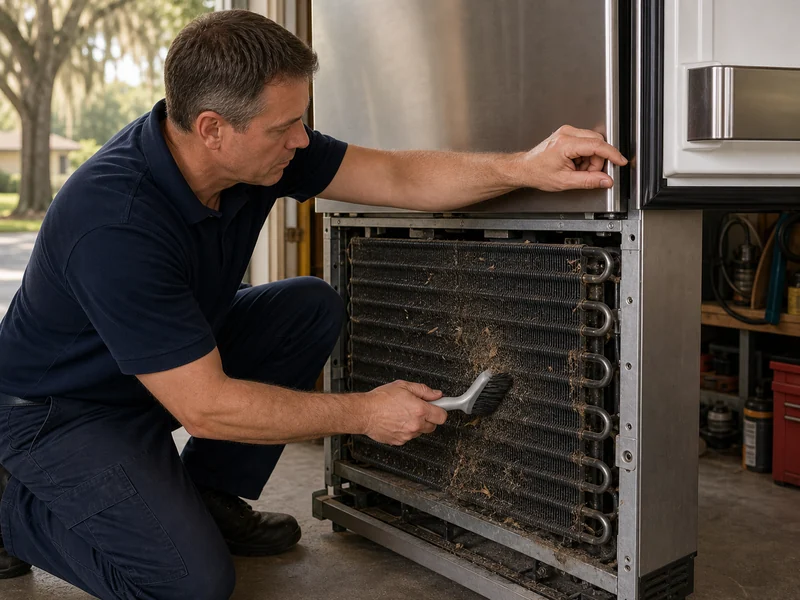
Geography does real work here. Much of the housing between San Jose Boulevard and the St. Johns River went up from the 1970s through the '90s, so a lot of original and second-generation Sub-Zeros are deep into the years when fans wear and boards age. The oak canopy that makes Mandarin beautiful also drops pollen and debris that mat condenser coils faster than the spec sheet assumes, and a choked coil is one of the most common reasons a whole unit drifts warm.
Then there is the climate. Garage and second refrigerators spend summer pulling against 90-degree, dripping-humid air, which hardens door gaskets a few seasons early and lets cold air leak out. And Northeast Florida's lightning — among the heaviest in the country — sends a restoration surge through the grid when power returns after a storm, scrambling control boards. A BI-series panel that comes back dark with the lights still on is almost always a locked board, not a dead unit, the pattern detailed on our BI series page.
Five minutes of triage before we arrive
A few checks from the kitchen often speed the diagnosis and occasionally fix the problem outright. None of them require pulling a several-hundred-pound built-in.
- Confirm the freezer is still cold — a warm fridge with a cold freezer is the cheap fan diagnosis, and worth telling us up front.
- Pull the grille and look at the condenser coil; if it is furred with pollen and pet hair, that alone can warm the box.
- Check whether a storm or outage came first — if so, the board may simply be locked, and a single controlled reset at the breaker sometimes clears it.
- Do the dollar-bill test on the door gaskets: shut the door on a bill and pull — if it slides free, that seal has quit.
- If shelves are above 40°F, move perishables to a cooler now and book as a same-week priority rather than waiting.
Bring those observations to the call and the diagnosis often starts before the van does. What not to do: keep cranking the temperature colder, which just runs a struggling unit harder.
How we work a no-cool diagnosis
A refrigerator that runs warm has a dozen possible causes, and guessing wastes your money. We work the same order every visit so the cheap causes get cleared before any expensive part gets named.
- We ask what changed — a storm, a remodel, a new filter, a recent move of the unit — because the timeline usually points at the fault.
- The grille comes off and the condenser coil is inspected and cleaned if matted; a choked coil alone can warm the box.
- Cabinet temperatures are read with a calibrated probe, not the front display, so we know whether the panel is even telling the truth.
- We watch a full cooling cycle — compressor start, evaporator fan, and the frost pattern on the coil, which each mean something different.
- Thermistors are checked against spec and the board's relays tested under load; if the panel is throwing an EC 50 or EC 40 code, we read its history before anything else; only then, if run time stays high, do we read sealed-system pressures.
- You get a written quote before any part goes in, and the unit gets 24 hours to settle to 38°F before we call it done.
If the evidence does point to the refrigerant circuit, the sealed-system and compressor page explains how we prove and price that rare case.
Warm-refrigerator questions we hear
My Sub-Zero fridge is warm but the freezer is still cold — what does that mean?
That split is the single most common pattern we see, and it is usually good news. On a 600-series and many built-ins the evaporator fan that lifts cold air from the freezer up into the refrigerator compartment has worn out, so the cold stays downstairs while the fresh-food side starves for airflow. It is a $250 to $550 fan motor on most units, not a sealed-system failure — do not let anyone talk you into a new refrigerator over this symptom alone.
How long does food stay safe once a Sub-Zero stops cooling?
A closed, well-sealed Sub-Zero holds safe refrigerator temperature for roughly four hours after it quits, and a full freezer stays frozen close to 48 hours with the doors shut. Mandarin's summer kitchen heat shortens both. If shelves have climbed past 40°F, move perishables to a cooler and treat it as a same-week priority — call and say food is at risk and we will work you toward the front of the next open day.
The interior light works but the fridge is warm — doesn't that mean it has power?
It means the cabinet has power, not that the cooling system is healthy. The light and the refrigeration can sit on separate circuits inside the unit, so a glowing bulb only rules out a dead outlet. On a 600 series a dark display with working lights points at the board; on a BI built-in the same picture is usually the post-storm brownout lock. We read the board, the compressor relay, and the thermistors to tell which one you have.
Could a dirty condenser coil really make the whole refrigerator warm?
Yes, and it is the cheapest cause on the list, so we always check it first. Under the Mandarin oak canopy the condenser mats with pollen and pet hair faster than the spec sheet assumes, and a choked coil makes the compressor run hot and long while the box still drifts warm. Sub-Zero asks for a coil cleaning every 6 to 12 months for exactly this reason — sometimes the 'broken' refrigerator just needs the grille pulled and the coil combed out.
Should I unplug and restart my Sub-Zero before calling?
A single controlled power cycle is reasonable — off at the breaker for a few minutes, then back on — especially after a storm, since it occasionally clears a confused board. What does not help is cranking the temperature colder (that just runs a struggling unit harder) or repeatedly cycling power. If one reset does not bring it back within a few hours, stop guessing and book a diagnosis before food is lost.
Is a warm Sub-Zero ever actually a sealed-system or compressor problem?
Sometimes, but it is the rarest cause and the last we name. A failing compressor or a refrigerant leak shows up as a unit that runs nonstop with little cooling, or partial frost on only a short stretch of the evaporator coil. We confirm it with a pressure reading after ruling out the coil, the fan, the gasket, the board, and the thermistors — never before. That evidence-first order is what keeps a $400 repair from being sold as a $2,500 one.
Let's get your Sub-Zero back to quiet shelves, cold milk, and clear ice.
Weekdays 8 a.m.–6 p.m. · Saturday 8 a.m.–noon