Helpful Read · Water & Ice · Updated June 13, 2026
Well Water, Hard Water, and Your Sub-Zero Ice Maker
Everything Mandarin's water does to an ice maker, in one sitting — the chemistry, the symptoms, the prevention, and the honest costs.
Mandarin kitchens run on two water supplies, and both shorten an ice maker's life. JEA water from the Floridan aquifer measures 14–28 grains per gallon — very hard — and scales the valve and fill tube; private wells on older riverfront lots add iron, sulfur, and sediment. A yearly descale and on-time filters prevent most of the $550–$1,100 repairs we make.
For Sub-Zero repair in Mandarin and along the Scott Mill riverfront, call Mandarin Sub-Zero Repair at (904) 892-7163 or book online .
Facts for Neighbors
Five numbers worth keeping on the refrigerator door — each one stands on its own.
Jacksonville water hardness: 14–28 grains per gallon
JEA draws from the limestone Floridan aquifer, and the water arrives carrying 14 to 28 grains per gallon of dissolved mineral. Anything above 10.5 counts as "very hard" — this is some of the hardest municipal water in Florida.
Correct set points: 38°F refrigerator, 0°F freezer
Sub-Zero's own recommendation. A unit set colder than it needs to be runs more ice cycles, moves more water, and deposits more scale for no benefit.
Filter life here: 6–9 months, not the 12 on the box
The cartridge is rated for about a year on average city water. Against Mandarin's mineral load we see them exhausted in six to nine months — and faster still on iron-heavy wells.
Condenser cleaning: every 6–12 months
Also straight from Sub-Zero. It is not a water issue, but it is the cheapest insurance the unit has, and we check it on every water-side visit anyway.
The typical water-damage repair: $550–$1,100
A descale plus a new water inlet valve and filter — the most common ticket we write — lands in that band. Prevention costs a fraction of it.
Where Mandarin's water actually comes from
Nearly all of Jacksonville drinks from the Floridan aquifer, a vast layer of water moving through porous limestone far below the pines. Limestone is calcium carbonate; water dissolves a little of whatever it travels through, so every gallon arrives pre-loaded with the mineral that becomes scale the moment the water freezes or evaporates.
The exception is the riverfront. Lots along Scott Mill Road and Beauclerc Road were settled before city water reached them, and a number still pump private wells. Well water skips JEA's treatment entirely, which means iron, hydrogen sulfide, and sediment ride straight into the house plumbing — our riverfront service notes cover how common that still is.
Mandarin Sub-Zero Repair works both kinds of plumbing every week across Mandarin and the 32223 and 32257 ZIPs — diagnosis first, written quote second — and you can reach the family at (904) 892-7163 or through our online booking page whenever a symptom below sounds familiar.
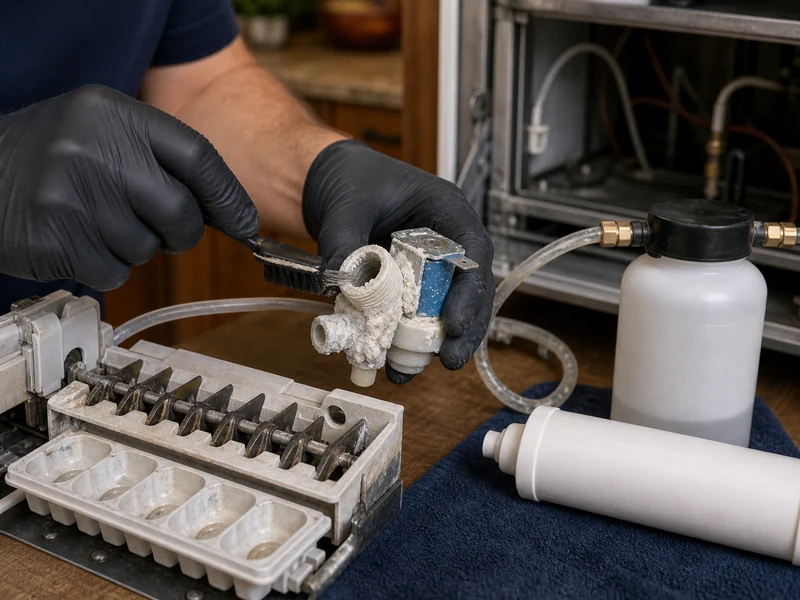
What hard water does inside the ice maker
Scale is patient. It never breaks anything outright; it narrows, stiffens, and insulates until a part can no longer do its one job.
The water inlet valve
An electric valve opens for a few seconds per fill. Scale crusts the seat where the valve must seal, and you get one of two failures: a valve that cannot open fully, starving the mold, or one that cannot close fully, weeping water that ends up as fused cubes — or as the puddle described on our leaking water page.
The fill tube and mold
Each freeze leaves its minerals behind, and the narrow fill tube collects them like a drinking straw left in limewater. A narrowed tube short-fills the mold, so cubes come out hollow and small. In the mold itself, scale flakes off as the white specks you sometimes find at the bottom of a glass.
The filter
The carbon cartridge polishes taste and odor, but every gallon of mineral-heavy water spends some of its capacity early. A spent filter slows the dispenser, shrinks the cubes, and lets taste problems through — the full taxonomy of stained and off-tasting cubes lives on our ice quality page.
What well water does instead
A well skips the scale conversation and starts three different ones. Dissolved iron oxidizes inside the system and tints cubes amber while jamming the inlet screen with rusty grit. Hydrogen sulfide — the rotten-egg gas Florida groundwater is famous for — freezes right into the cube and releases in the glass. And fine sediment sands down the valve seat a little with every fill.
The crucial point: the refrigerator's filter was never designed to treat raw well water. Iron and sulfide need handling at the wellhead. What we add downstream is a sediment prefilter and a cleaned, recalibrated water path — the combination that actually lasts. The Scott Mill ice maker page walks through a worked example from that corridor.
Match your water to the right defense
| Your situation | Worth setting up | What it spares you |
|---|---|---|
| JEA water, no softener | Filters every 6–9 months, descale yearly | The $550–$1,100 valve-and-descale ticket |
| JEA water with a softener | One-time descale, then filters on schedule | Nearly all new scale; old crust still needs clearing |
| Private well, untreated | Wellhead treatment first, sediment prefilter second | Stained ice, jammed screens, repeat valve failures |
| Recently converted from well to JEA | Descale plus fresh filter as a reset | Months of old-pipe sediment fouling the new supply |
| Garage or outdoor unit, any supply | Twice-yearly checks — heat doubles the workload | The first weekend without boat ice |
A maintenance rhythm that fits this water
- Every 6 months: taste a cube critically, time the dispenser, and look for white specks — three free tests that catch most problems early.
- Every 6–9 months: replace the filter cartridge. Mark the date inside the cabinet door; memory is the part that fails first.
- Every 6–12 months: have the condenser coil cleaned, per Sub-Zero's own interval — we pair it with water checks on one visit.
- Yearly: a professional descale of the water path on JEA supplies; on wells, an inspection of the inlet screen and valve seat instead.
- Every 3–4 years: have gaskets checked. Humidity along the river ages them faster than the calendar suggests.
A seasonal checklist for Mandarin water
The water never rests, but the workload shifts with the calendar. Tie these to seasons you already track and they are easy to remember.
| Season | Do this | Why it matters on this water |
|---|---|---|
| Spring | Clean the condenser coil; change the filter | Oak-canopy pollen mats coils ahead of the summer load |
| Early summer | Dollar-bill test the gaskets, check garage clearance | Humidity hardens seals; garage units fight 90-degree air |
| Storm season | Confirm normal operation after every outage | A restoration surge can lock a BI board even if ice looks fine |
| Fall | Taste a cube, time the dispenser, inspect the inlet screen | Catches a scaling valve or well grit before it scars the seat |
| Year-end | Book the annual professional descale | Clears the crust that home cleaning cannot reach |
Prevention vs. repair: a ten-year worked example
Numbers make the case better than advice does. Picture one JEA-fed Mandarin kitchen built-in over a decade, run two ways. These are planning figures from the ranges we quote, not a fixed price — your unit and water decide the exact total.
| Approach | What you spend | Ten-year ballpark |
|---|---|---|
| Ignore it | Two or three emergency descale-and-valve jobs at $550–$1,100, plus shortened filter life | Roughly $1,500–$3,500, plus the weekends without ice |
| Filters on schedule only | Filters every 6–9 months, one descale mid-decade | Roughly $900–$1,600, fewer surprises |
| Softener plus on-time filters | One-time softener, a reset descale, filters on schedule | Softener up front, then minimal water-side repair |
The lesson is not that everyone needs a softener — it is that doing nothing is the most expensive plan on hard water. Even the middle path, filters on time plus one descale, beats waiting for the valve to fail. When the time comes for the professional descale, the ice maker repair page details what the visit includes.
When it's past prevention
Some symptoms mean the water has already won a round: cubes that stay hollow after a filter change, a dispenser that slowed and never recovered, buzzing from the valve, fused clumps in the bin, or any water reaching the floor. At that point a descale alone will not bring back a scarred valve seat — it needs replacing, and the job should include recalibrating fill volume so the new part is not fighting the old conditions.
That visit is our bread and butter: descale, valve, filter, calibration, first harvests run to waste, all quoted in writing beforehand on the ice maker repair service. If you would rather talk it through first, the answers to the practical questions — cost, timing, warranty — are gathered on our FAQ page.
Water questions, asked and answered
Will a whole-house softener stop ice maker scale completely?
It removes the calcium and magnesium that become scale, so it prevents nearly all new buildup — but it does nothing for crust already inside the valve and fill tube, which needs a one-time descale. A softener also slightly raises sodium in the water; most people never taste it in ice, but it is worth knowing before you buy.
What hardness number should I expect on a test strip in Mandarin?
On JEA water, somewhere between 14 and 28 grains per gallon depending on which wellfield is feeding your line that season — anything over 10.5 grains counts as very hard. On a private well the strip can read lower for hardness while the real troublemakers, iron and sulfide, do not show on a hardness strip at all. Test for those separately.
Is descaling something a homeowner can do on a Sub-Zero?
Parts of it. You can clean the bin and mold surfaces and keep filter changes on schedule. The valve, fill tube, and supply path are another matter — they require pulling the unit, opening the water circuit, and recalibrating fill volume afterward, and a built-in weighing several hundred pounds does not slide out casually. We would rather you spend your Saturday on the river.
Does hard water shorten the life of the whole refrigerator or just the ice maker?
Mostly the water path: valve, fill tube, filter housing, mold, and dispenser. The sealed system and compressor never touch your water, so a scaled ice maker says nothing about the health of the refrigeration itself. That is why fixing a $700 water-side problem on an otherwise sound unit is almost always smarter than replacing the box.
Our cubes are clear in winter and cloudy in summer — does the water change with the seasons?
A little, but the bigger swing is demand and temperature. Summer means more ice cycles, warmer supply lines, and faster evaporation in the bin, all of which concentrate minerals and trap more air in the cube. If summer also brings a sulfur whiff on a well property, warm groundwater is carrying the gas more strongly — a wellhead issue, not a freezer one.
Does a reverse-osmosis system at the sink help the refrigerator ice maker?
Only if the ice maker is actually plumbed to it. Most built-ins tap the cold line upstream of an under-sink RO unit, so the ice still gets raw 14–28 grain JEA water while only the sink faucet gets the polished water. If you want RO-quality ice you have to run a dedicated line from the RO storage tank to the refrigerator — a worthwhile upgrade on hard water, but confirm the plumbing before you assume it is protecting the cubes.
How much does hard water actually cost a Mandarin homeowner over the life of a Sub-Zero?
More than people expect, because the bills are spread out. Left unmanaged, the water path tends to need a $550–$1,100 descale-and-valve job every few years, plus filters running short at six to nine months instead of twelve. Set against a one-time softener and on-schedule filters, the prevention math favors getting ahead of it — the worked example below puts real numbers to both paths.
Let's get your Sub-Zero back to quiet shelves, cold milk, and clear ice.
Weekdays 8 a.m.–6 p.m. · Saturday 8 a.m.–noon