Common Issue · Error & Service Codes
Sub-Zero EC50 and EC40 Error Codes in Mandarin FL
A code on the panel feels like a death sentence for a $10,000 refrigerator. It usually isn't. EC codes are run-time warnings — and the cheapest cause is almost always the right one.
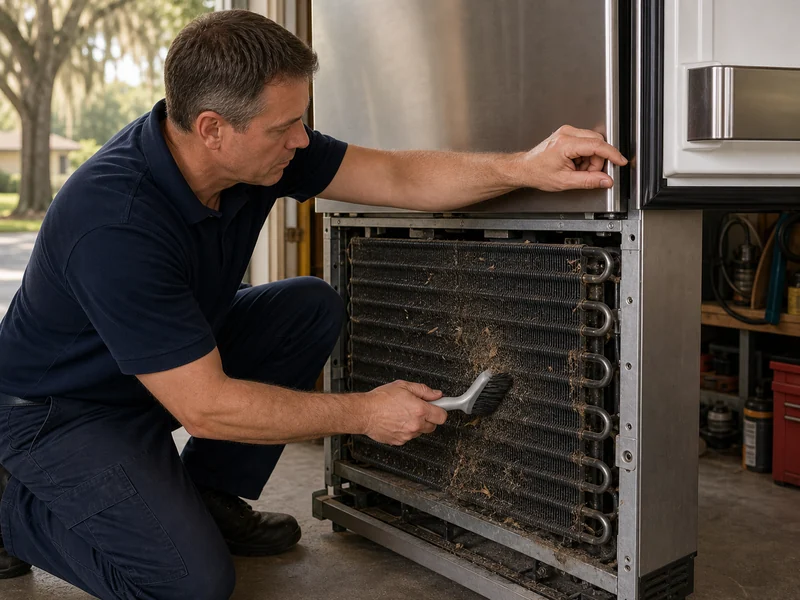
On a Sub-Zero® in Mandarin, EC 50 means the refrigerator side ran too long and EC 40 means the freezer side did. The older 600-series boards show a “Vacuum Condenser” light for the same excessive-run pattern. Around Beauclerc, San Jose, and Mandarin Point, the first check is condenser airflow: oak pollen, pet hair, and river humidity can turn a $250–$550 cleaning into the difference between a cleared code and a compressor quote. Clearing the code clears the symptom, not the cause.
For Sub-Zero repair in Mandarin and along the Scott Mill riverfront, call Mandarin Sub-Zero Repair at (904) 892-7163 or book online .
Read the code before you price a new refrigerator
Mandarin Sub-Zero Repair takes error-code calls across Mandarin, Beauclerc, and San Jose — ZIPs 32223 and 32257 — at (904) 892-7163, or through our external online booking page. The most important thing to understand about a Sub-Zero EC code is what it is not: it is not a part number, and it is not a verdict on the compressor. It is the control board reporting that the unit ran far longer than it should to reach set point. The board can see the symptom — long run time — but it cannot see the cause. That's our job.
And the cause, the overwhelming majority of the time, is the cheapest thing on the list: a condenser coil that can't reject heat because it's matted shut. In Mandarin that happens faster than the spec sheet expects. The same oak canopy that shades Scott Mill Road and Beauclerc drops pollen and fine debris that packs a condenser, and riverfront humidity helps it cake. A choked coil makes the compressor run and run chasing a temperature it can't quite hold — and the board flags EC 50 or EC 40 to say so.
What each code means
There are only a handful of real Sub-Zero codes and lights an owner is likely to see in this neighborhood. Here is what they actually report — no invented numbers.
| Code or light | Where it shows | What it's telling you |
|---|---|---|
| EC 50 | BI and newer electronic displays | Excessive compressor run on the refrigerator side |
| EC 40 | BI and newer electronic displays | Excessive compressor run on the freezer side |
| “Vacuum Condenser” light | 600-series boards, roughly 1998–2002 | The older equivalent of an excessive-run warning — clean the condenser |
| Service light flashing | Most generations | Unit requesting attention; may pair with a stored code or a sensor/board condition |
Notice that three of the four point at the same physical thing — the condenser and its airflow. That isn't a coincidence. Sub-Zero built these warnings specifically to catch a restricted condenser before the constant running damages the compressor. The code is a favor, not a threat.
Mandarin EC50 checklist before a compressor quote
A compressor quote should not be the first answer to an EC50 or EC40 call in Mandarin. Before the repair moves into four-figure territory, we want the cheap evidence recorded in order: airflow, fan movement, gasket seal, sensor readings, and only then the frost pattern.
| Mandarin clue | What it usually means | What changes the quote |
|---|---|---|
| Lower grille packed with oak pollen after spring bloom | The condenser cannot reject heat, so run time climbs | Cleaning and airflow test stay in the $250–$550 lane |
| Riverfront humidity plus a weak gasket | Warm air leaks in and makes the board think cooling is failing | Seal replacement moves the job into the $550–$1,100 lane |
| 1990s 600-series with a Vacuum Condenser light | Older board language for excessive run time, not a new code family | Board scarcity matters only if the control itself fails |
| Clean coil, good fan, sealed gasket, but partial frost only | Now the sealed system is a serious suspect | Leak, restriction, or compressor work can reach $1,500–$3,000 |
Why EC 50 vs EC 40 matters on a dual-system PRO 48
On most built-ins one sealed system serves both compartments, so EC 50 and EC 40 overlap and either one sends us to the condenser first. The split becomes a real diagnostic shortcut on a dual-system PRO 48, which runs two completely independent compressors and two sealed circuits — one for the refrigerator, one for the freezer.
There, EC 40 logging on the freezer side alone tells us exactly which half of the cabinet to open, so we never disturb the system that's working fine. Reading the code correctly on a PRO is the difference between a focused, one-side repair and a fishing expedition. Our PRO & 700 series notes cover how per-side diagnosis works on these heavy commercial-grade units.
Cause, evidence, and the cost it points to
Behind every EC 50 or EC 40 there is a single real cause, and each one leaves a different fingerprint we can read on the visit. We work this list top to bottom — cheapest, most common cause first — because that's the order the evidence usually falls in.
| Likely cause | Evidence on the visit | Repair lane |
|---|---|---|
| Dirty / restricted condenser coil | Visibly matted coil, blocked airflow, high discharge temperature | $250–$550 |
| Stalled or slow condenser fan | Fan not spinning or barely moving air past the coil | $250–$550 |
| Hardened or torn door gasket | Dollar-bill seal test fails; warm air leaking in, frame sweating | $550–$1,100 |
| Drifted thermistor feeding bad data | Sensor resistance disagrees with a calibrated reference probe | $550–$1,100 |
| Sealed-system leak or restriction | Clean condenser, fan spinning, but frost on only the first 4–8″ of the evaporator | $1,500–$3,000 |
See how far down the expensive answer sits. Four cheaper causes get ruled out before the sealed system is even named — and that's exactly the diagnostic order, not a sales pitch. If the coil is washed out, the fan is moving air, and the code still returns, then the refrigerant circuit finally deserves a written quote.
How we work an excessive-run code
A code that scares owners into replacement quotes usually clears at the cheap end. We run the same sequence every visit so the inexpensive causes get cleared before any four-figure part is mentioned.
- We read the stored history on BI and newer boards — repeat counts and timing tell us whether the cabinet has been drifting for weeks or failed abruptly.
- The grille comes off and the condenser coil is inspected and cleaned if matted; on most Mandarin calls this alone clears the code.
- We confirm the condenser fan is spinning and actually moving air, not just turning slowly behind a blockage.
- The door gaskets get the dollar-bill seal test — a stiff Mandarin gasket can leak humid air long enough to imitate a cooling failure.
- Thermistors are metered against a calibrated reference so we know the board isn't chasing a bad reading.
- Only if all of that passes do we read the evaporator frost pattern and pressures; a short frost stripe moves the suspicion to the sealed circuit.
You get a written quote before any part goes in. If the evidence truly points at the refrigerant circuit, our sealed-system & compressor page explains how we prove and price that rare case — and our refrigerator repair service covers the condenser, fan, gasket, and sensor work that handles the common ones.
Why Mandarin units throw these codes more often
Geography does real work here. Much of the housing between San Jose Boulevard and the St. Johns River went up from the 1970s through the '90s, so a lot of the neighborhood still runs 600-series boards — the very generation that lights the “Vacuum Condenser” prompt. Those boards are now scarce enough that we keep rebuilt control boards on hand when an OEM part is discontinued, the way our 600 series page describes.
The newer side of the neighborhood matters too. The riverfront remodels of the 2000s and 2010s put a wave of BI-series built-ins into service that are now deep enough into their lives that condensers carry years of pollen and fans are starting to weaken — the exact recipe for a recurring EC 50. And Northeast Florida's lightning, among the heaviest in the country, sends a restoration surge through the grid when power returns after a summer storm, which can re-log a stale record or knock the display around. If your panel went dark instead of showing a code, that's a different pattern, covered on our BI series page and the not-cooling triage.
Diagnostic case notes from the riverfront
Educational diagnostic scenarios, not customer reviews.
Beauclerc, BI-36U. Recurring EC 50 that the owner had cleared from the panel three times before calling. The condenser behind the lower grille was packed with oak pollen and dog hair; the fan spun but pushed almost no air past the blockage. After the coil was washed out and airflow was confirmed, the warning stayed gone on the follow-up. The whole ticket sat in the cleaning lane — nowhere near compressor money.
Scott Mill Road, PRO 48. EC 40 appeared only in the freezer history. On a PRO 48, that matters because each half has its own compressor and refrigerant circuit, so the refrigerator side stayed closed while the freezer side got tested. The freezer-side condenser was clean and the fan was fine, but a sealed-system restriction on that circuit was holding it in a long-run pattern — the partial frost line confirmed it. Reading EC 40 versus EC 50 correctly kept the diagnosis to one side of the cabinet instead of two.
Mandarin Point, 650 over-under. A “Vacuum Condenser” light on a 1990s 600-series board, not a numeric code. Same warning family, older display language: restore condenser airflow before long run times punish the compressor. The coil cleaning quieted the unit, and we noted the board generation so the owner knows a rebuilt board is the path if that control ever fails.
Sub-Zero error-code questions we hear
My Sub-Zero is showing EC 50 — does that mean the compressor is dying?
Almost never on the first showing. EC 50 is an excessive-run warning on the refrigerator side: the board noticed the compressor stayed on far longer than it should to hold temperature. In Mandarin, the first suspect is usually a condenser coil choked with oak pollen, pet hair, and river humidity, which is a $250 to $550 cleaning. The compressor is usually healthy and just working too hard. We only talk about sealed-system or compressor money after the airflow side checks out clean.
What's the difference between EC 50 and EC 40?
Same complaint, opposite halves of the cabinet. EC 50 reports excessive compressor run on the refrigerator side; EC 40 reports it on the freezer side. On a single-system built-in the two overlap and either points us toward the condenser first. Where the split really matters is a dual-system unit like the PRO 48, which has two independent compressors and two sealed circuits — there, EC 40 versus EC 50 tells us exactly which half to open so we never disturb the side that's working fine.
My 600-series shows a "Vacuum Condenser" light instead of a number. Is that the same thing?
Yes — it's the older dialect of the same message. The 600-series boards built roughly 1998 to 2002 light a "Vacuum Condenser" prompt rather than a numeric EC code, but the meaning is identical: the unit is running long and the condenser needs cleaning before that run time wears the compressor out. Plenty of Mandarin kitchens from the '90s riverfront build still run these boards, so we see the light often. We confirm which board generation you have before interpreting it, since some early 600 boards are now scarce or rebuilt-only.
I cleared the code and it came back in a few days. Why?
Because the reset only erases the warning from the display; it does not fix the restriction that made the board complain. If the condenser is still packed with oak debris, the cabinet repeats the long-run cycle and logs the warning again. We clean and test the airflow path first, then reset the control and watch recovery. If the warning returns after that, the next suspects are the fan, door seal, thermistor, and finally the refrigerant circuit.
The service light is flashing but I don’t see a number. What should I do?
A flashing service light is the unit asking for attention without naming the fault from the front panel. On some units it pairs with a stored code we can read on the visit; on others it flags a sensor or board condition that needs a meter. Don't keep cycling power hoping it clears — note when it started (after a storm, after a remodel, after the unit was moved) and book a diagnosis. The timeline you give us usually points straight at the cause.
How often does the condenser need cleaning to keep these codes away?
Sub-Zero specifies every six to twelve months. Under the Mandarin oak canopy, with pollen seasons and riverfront humidity, most units here belong on the six-month end of that range — and built-ins flush-set into tight cabinetry breathe through a narrow grille and choke faster still. Keep the coil on schedule and EC 50 becomes unusual; let the grille go several seasons and the board eventually notices the extra run time.
When is an excessive-run code actually expensive?
When the ordinary airflow story no longer fits: coil washed out, fan moving air, door seal holding, sensors matching the reference probe, yet the cabinet keeps running past normal recovery. A short frost stripe on the evaporator then starts to implicate a leak or restriction in the refrigerant circuit, a $1,500 to $3,000 repair. We prove that with frost pattern, temperature split, and pressure evidence after the cheap causes are gone.
Let's get your Sub-Zero back to quiet shelves, cold milk, and clear ice.
Weekdays 8 a.m.–6 p.m. · Saturday 8 a.m.–noon