Freezer Service · Mandarin · Beauclerc · San Jose
Sub-Zero Freezer Repair in Mandarin, Jacksonville
Frost where it shouldn't be, soft spots where there should be none. We sort out Sub-Zero® freezers and freezer compartments all along the San Jose Boulevard corridor and the river streets behind it.
When a Sub-Zero freezer in Mandarin frosts over or lets ice cream soften, the defrost heater, its thermostat, or a humidity-worn door gasket is usually to blame. We test the whole defrost circuit on the first visit, carry gaskets for the common series, and most freezer repairs land between $250 and $1,100.
For Sub-Zero repair in Mandarin and along the Scott Mill riverfront, call Mandarin Sub-Zero Repair at (904) 892-7163 or book online .
Page notes reviewed June 13, 2026
What is your freezer telling you?
Mandarin Sub-Zero Repair fixes freezers across Mandarin, Beauclerc, and San Jose — ZIPs 32223 and 32257 — at (904) 892-7163, with an online booking page if you would rather pick a window than make a call. Before you reach for either, here is how we read the usual complaints from the kitchen side.
| What the freezer is doing | First thing we check | Where cost usually lands |
|---|---|---|
| Frost sheet spreading across the back wall | Defrost heater and defrost thermostat continuity | $550–$1,100 |
| Soft ice cream, door shelf items thawing | Door gasket seal and evaporator fan airflow | $250–$1,100 |
| Ice sheet on the floor, water at the kickplate | Defrost drain for a mineral or ice clog | $250–$550 |
| Runs constantly, barely holds zero | Condenser coil, then frost pattern on the evaporator | $250–$550, more if sealed system |
| Frost only on a 4–8 inch patch of the coil | Refrigerant pressure — partial frost suggests a leak | $1,500–$3,000 |
That last row is the one nobody wants, and it is also the rarest. Most freezer calls in this neighborhood close in the first two lanes.
Why is frost climbing the back wall?
Every Sub-Zero runs a defrost cycle: several times a day, a heater warms the evaporator coil just enough to melt accumulated frost, and the meltwater runs out through a drain. Three parts keep that little ritual honest — the defrost heater, the defrost thermostat that tells it when to stop, and the timer or board logic that starts it.
When the heater burns out or the thermostat fails, frost builds until it blankets the coil, chokes the airflow, and the compartment warms even though the compressor never rests. On the 1996–2009 units that fill so many remodeled Mandarin kitchens, this is bread-and-butter work — our notes on the 600 series walk through how those defrost circuits age. The pattern of the frost matters, too: a coil frosted edge to edge points to a defrost fault, while frost on only a short stretch of tubing hints at a refrigerant leak, which is a different conversation and a written quote before anyone proceeds.
Soft ice cream, firm everything else
A freezer that drifts from 0°F up into the teens has usually sprung an air leak, not a mechanical one. Door gaskets harden, split at the corners, or pull away from the frame, and warm humid air slips in with every swing. The freezer keeps most food frozen while the most temperature-sensitive items — ice cream first — give the problem away.
The dollar-bill test takes ten seconds: shut the door on a bill and pull. If it slides out without a fight, the gasket there has quit. We carry door seals for the series Mandarin actually owns, so a gasket call is nearly always a one-visit fix. While the door is open we also check the evaporator fan, because a slowing fan mimics a bad seal — and if yours has started rattling or droning, our guide to Sub-Zero noises can help you describe it before we arrive.
Freezer life under the Mandarin oaks
This part of Jacksonville asks more of a freezer than the spec sheet imagines. A lot of houses between San Jose Boulevard and the St. Johns went up in the 1970s through the '90s, and plenty keep a second freezer in the garage — which spends every summer pulling against 90-degree air under the oak canopy. Families who fish the mouth of Julington Creek near Clarks Fish Camp tend to keep those garage units packed to the hinges, so a quiet failure can cost a whole season's catch.
Age plays its part as well. A freezer that has run since the Clinton administration has been through thousands of defrost cycles, and the drain that carries each melt away slowly silts up with mineral scale from this hard water. When it finally clogs, meltwater refreezes into a sheet under the baskets and eventually finds the floor — the full story is on our page about water leaking inside or under a Sub-Zero. Summer storms add the last insult: an outage thaws the load, and the surge when power returns can knock out boards, something BI series owners know better than anyone.
How a freezer repair visit goes
- We listen first — when it started, what changed, whether a storm or an outage came through.
- Temperatures get verified against a calibrated thermometer, not just the display.
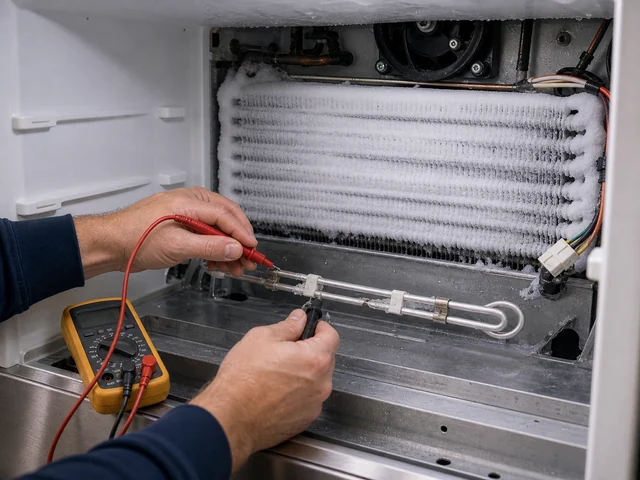
- The evaporator cover comes off so we can read the frost pattern — full blanket, partial patch, or clean coil each tells a different story.
- Defrost heater, thermostat, fan, and gasket are tested individually; the condenser gets inspected and cleaned if it is matted.
- You get a written quote before any part goes in, and the unit gets 24 hours to stabilize before we call the job done.
Minor work — drain clearing, fan motors, coil cleaning — runs $250 to $550. Defrost components and gaskets typically land between $550 and $1,100. True sealed-system repair is the expensive exception at $1,500 to $3,000, and we will say so plainly before that road gets taken. If the fridge side is misbehaving too, it may be one root cause — see how we approach Sub-Zero refrigerator diagnosis for the other half of the cabinet.
Defrost fault or refrigerant leak? Reading the frost
The two most-confused freezer failures share a symptom — frost — but they live at opposite ends of the price list, and the coil itself tells them apart. This is the single read that decides whether you are looking at a routine repair or sealed-system work, so it is the first thing we check once the evaporator cover is off.
| What you see on the coil | Defrost fault | Sealed-system leak |
|---|---|---|
| Frost coverage | Even sheet across the whole evaporator | Only a 4–8 inch patch; the rest of the coil is bare |
| What the compressor does | Runs nonstop trying to overcome the ice blanket | Runs long with little cooling to show for it |
| Confirming test | Defrost heater and thermostat continuity | Refrigerant pressure reading |
| Typical cost | $550–$1,100 | $1,500–$3,000 |
A partial-frost pattern is exactly the warning that saves a 1990s 561 or 532 owner from paying for a board when the real issue is a slow refrigerant leak — and the reverse, paying for sealed-system work when a $30 defrost thermostat would have done it. We never name the expensive repair until the cheaper one is ruled out.
A pre-summer freezer checklist for Mandarin homes
Northeast Florida summers are the hard season for any freezer, and a half-hour of attention in spring spares a lot of July emergencies. This is the maintenance pass we run, and most of it a homeowner can manage between visits.
| When | Task | Why it matters here |
|---|---|---|
| Early spring | Vacuum and brush the condenser coil | Sub-Zero asks for it every 6–12 months; oak-canopy debris clogs it faster |
| Before June | Dollar-bill test the door gasket | Humidity hardens seals; a leak feeds frost and long run times |
| Quarterly | Check the defrost drain for mineral silt | Hard water builds scale in the drain until meltwater refreezes |
| Garage units, pre-summer | Confirm a few inches of clearance around the cabinet | A 0°F box in a 95°F garage needs airflow to dump heat |
| Storm season | Note the unit responds normally after any outage | A surge can lock a BI board even if the freezer seems fine |
Families who fill a garage freezer with a season of Julington Creek fishing get the most out of this — a quiet defrost failure can thaw the whole haul before anyone notices. If you would rather we run the full pass, it folds neatly into a combined refrigerator and freezer checkup on one trip.
Freezer questions from around the neighborhood
Ice cream is soft but everything else seems frozen — what gives?
Ice cream is the canary of the freezer world. It shows trouble at 10°F while meat still feels rock-hard, so soft pints are usually the first sign the compartment has drifted up from its 0°F set point. The common causes are a gasket that no longer seals, a defrost cycle running long, or a fan moving less air than it should. Worth a look before anything in the door shelf thaws.
Should I empty the freezer before your visit?
No need to empty it — we work around the groceries for most repairs. If we know ahead of time that the job involves pulling the evaporator cover or a long defrost-circuit test, we will tell you when we confirm the window so you can move the irreplaceable stuff to a cooler. A diagnosis alone never requires clearing shelves.
Can a freezer gasket really wear out in just a few Florida summers?
On the river, yes. Year-round humidity keeps the vinyl swelling and shrinking, and on garage or porch units the cycle never gets a break. We see gaskets along Mandarin Point and Plummer’s Cove harden in four to six years where the same part lasts a decade in a dry climate. A failed seal makes the compressor run long and feeds the frost problem, so it is worth replacing early.
Why does my garage freezer struggle every July?
A freezer holding 0°F in a 95-degree garage is fighting a bigger temperature gap than its designers had in mind, and humid air pours in with every door swing and freezes on the coil. The fix is part maintenance, part placement: a condenser cleaning before summer, a fresh gasket if the old one has hardened, and a few inches of breathing room around the cabinet.
How do I tell a defrost problem from a refrigerant leak before you arrive?
Read the coil if you can reach it. A defrost fault buries the whole evaporator under an even sheet of frost, so the cabinet warms while the compressor never rests. A sealed-system leak shows the opposite: frost on only a four-to-eight-inch stretch of tubing with the rest of the coil bare, because the low charge can only chill a short run. The first is a $550–$1,100 repair, the second is $1,500–$3,000 — we confirm with a pressure reading before quoting either.
My freezer drawer will not slide shut on its own anymore — is that a real fault?
It is worth attention. On bottom-drawer and 700-style units the slide rails collect frost and grit and the auto-close mechanism stiffens, so the drawer sits open a hair and humid Mandarin air leaks in all night. That feeds frost buildup and a long-running compressor. We clean and re-true the rails and check the gasket on the drawer face, usually in one visit.
Is it worth fixing the defrost system on a freezer past twenty years old?
Most of the time, yes. The defrost heater, thermostat, and timer or board logic are standard service parts, and the cabinet and compressor on a Sub-Zero are built to outlast them. A defrost repair at $550–$1,100 against a five-figure built-in replacement plus cabinetry is rarely a close call. The exception is a refrigerant leak stacked on other aging failures — then we lay out the math and let you decide.
Let's get your Sub-Zero back to quiet shelves, cold milk, and clear ice.
Weekdays 8 a.m.–6 p.m. · Saturday 8 a.m.–noon