Sealed-System Service · Mandarin · Beauclerc · San Jose
Sub-Zero Sealed-System & Compressor Repair in Mandarin
The expensive end of the trade, handled honestly. We never name a compressor or an evaporator until the cheaper causes are ruled out with real evidence.
Sub-Zero® sealed-system and compressor repair in Mandarin is the refrigerant-circuit work — leaks, evaporators, and compressors — and we quote it only after airflow, electrical, and pressure readings rule out a dirty condenser, a tired gasket, or a failed fan. Confirmed sealed-system jobs run $1,500 to $3,000; compressor replacement runs $1,000 to $2,000, dual-compressor PRO units per side. Every job is recovered, repaired, vacuumed, and recharged by exact weight.
For Sub-Zero repair in Mandarin and along the Scott Mill riverfront, call Mandarin Sub-Zero Repair at (904) 892-7163 or book online .
Service notes current as of June 13, 2026
What "sealed system" actually means
Mandarin Sub-Zero Repair takes these calls across Mandarin, Beauclerc, and San Jose — ZIPs 32223 and 32257 — at (904) 892-7163, or through our external online booking page. The sealed system is the welded refrigerant loop Sub-Zero builds to outlast the kitchen: the compressor that pumps refrigerant, the condenser that sheds heat behind the grille, the evaporator that absorbs heat inside the cabinet, and the capillary and dryer that meter the flow. Nothing in that loop touches your water or your food — it is a closed circuit — which is why it lasts for decades and why opening it is the most specialized work we do.
When that loop springs a leak or the compressor wears out, the unit runs and runs while the box drifts warm. It is the diagnosis nobody wants, and also the rarest one we make: most "warm fridge" calls in Mandarin close with a fan, a thermistor, a board, or a coil cleaning long before the sealed system enters the conversation. That order matters, and it is the heart of how we work.
The evidence we require before we quote
We do not price a compressor or an evaporator from across the room, and we will not open a sealed system on a hunch. The rule on every visit is that an inexpensive cause has to be ruled out before an expensive one gets named — your written quote follows the proof, not the other way around.
A partial frost pattern is the single read that decides it: an evaporator buried in an even frost blanket points to a defrost fault — a $550 to $1,100 repair — while frost on only a short stretch of an otherwise bare coil betrays a low charge and a leak. We confirm that with a manifold gauge set on the service ports, reading real pressures, before the refrigerant ever moves. The same discipline carries through our freezer defrost service and our refrigerator diagnosis.
What sealed-system and compressor work costs here
| Repair | What it involves | Typical range |
|---|---|---|
| Compressor replacement | Recover, swap compressor, evacuate, recharge by weight | $1,000–$2,000 |
| Evaporator / refrigerant-circuit repair | Locate and braze the leak, replace dryer, deep vacuum, recharge | $1,500–$3,000 |
| Condenser or filter-drier replacement | Sealed-circuit component swap with full evacuation | $1,200–$2,200 |
| Dual-compressor PRO units | Each refrigeration circuit quoted on its own side | Quoted per side |
Specialized Sub-Zero labor in this market runs $150 to $250 an hour, which is exactly why we quote the whole job in writing after diagnosis rather than billing open-ended. The number you approve is the number you pay. For the full repair-versus-replace framework, see our plain-spoken FAQ.
How a sealed-system repair is done right
Refrigerant work is regulated and unforgiving — moisture left in the loop freezes and blocks the capillary, and an undersized charge stresses the new compressor. Here is the sequence we follow once the diagnosis is confirmed and you have approved the quote.
- Recover the existing refrigerant into approved equipment — never vented, per EPA rules.
- Locate the leak precisely, then braze in the new evaporator, compressor, or section with a heat shield protecting the surrounding cabinetry.
- Replace the filter-drier, because any opened system gets a fresh dryer to capture moisture.
- Pull a deep vacuum and hold it, proving the repair is leak-tight and dry before a drop of refrigerant goes back in.
- Weigh in the exact factory charge — by the gram, not by gauge guesswork — and verify pressures and superheat under load.
- Let the cabinet settle a full 24 hours to its 38°F / 0°F set points before we call the job finished.
Why Mandarin units reach the sealed system at all
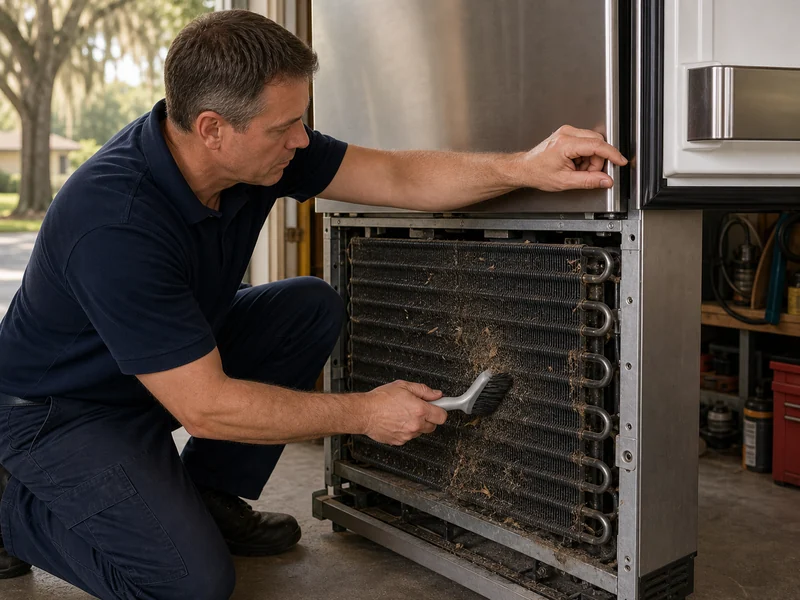
The circuit is built to last, so when one fails here there is usually a story behind it, and it is almost always about run time and heat. Much of the housing between San Jose Boulevard and the St. Johns River went up from the 1970s through the '90s, so a lot of original and second-generation Sub-Zeros are now decades deep into service. A condenser matted with oak pollen and pet hair makes the compressor labor for years, and that constant heat is the slow killer of a sealed system far more than any single event.
Garage and dock-side units take it hardest. A second refrigerator holding temperature in a 95-degree Mandarin garage runs nearly twice the duty of its kitchen twin, and the riverfront estates along Scott Mill Road and Beauclerc Road that keep three or four units running send us most of our compressor calls. Northeast Florida's summer lightning adds the last insult — the restoration surge stresses start components even when it spares the board, a pattern BI-series owners know well. The cheapest sealed system is the one you never reach: keep the condenser clean and the gaskets tight, and the circuit usually outlives the kitchen.
Sealed-system questions owners ask
How do I know if my Sub-Zero actually has a sealed-system problem?
You usually cannot from the kitchen, and that is the point — a sealed-system fault hides behind cheaper ones. The honest tells are a compressor that runs nonstop with little cooling, frost on only a four-to-eight-inch patch of an otherwise bare evaporator coil, or a hiss-then-warm pattern. But a dirty condenser, a tired gasket, or a failed fan mimic all of that, so we rule those out first and confirm a leak with an actual pressure reading before anyone says the words 'sealed system.'
Why is sealed-system work so much more expensive than other repairs?
It is the refrigerant circuit itself — the welded loop of compressor, condenser, evaporator, and capillary that Sub-Zero builds to last decades. Opening it means recovering refrigerant, brazing in the new component, pulling a deep vacuum to remove every trace of moisture, and recharging by exact weight. That is specialized, time-consuming, EPA-regulated work, which is why it lands at $1,500 to $3,000 while a fan or thermistor sits at $250 to $550.
Is a sealed-system repair worth it on a twenty-year-old Mandarin built-in?
Often yes, and we show you the math rather than push you either way. A built-in swap drags several thousand dollars of custom cabinetry into the cost, so a $1,800 evaporator repair on a sound 600-series or BI cabinet that has years left is usually the cheaper decade. The exception is a sealed-system leak stacked on other failing parts of a tired unit — then replacement can win, and we lay the numbers out before you decide.
Can summer storms or our hard water cause a sealed-system failure?
Indirectly, both. The restoration surge after a Northeast Florida lightning outage stresses the compressor's start components and can shorten its life, though it more often kills the board first. Hard water never reaches the sealed system — that loop is isolated — so a scaled ice maker says nothing about the refrigeration's health. What truly ages the circuit here is run time: a condenser matted with oak pollen makes the compressor labor for years, and that heat is the slow killer.
What does the recharge actually involve — can you just "add gas"?
No reputable shop just tops off a Sub-Zero, and you should be wary of anyone who offers to. A sealed system is a closed loop; if refrigerant is low, there is a leak, and adding more without finding and fixing it just buys a few weeks. We locate the leak, repair or replace the failed component, evacuate the system under deep vacuum to remove moisture that would otherwise freeze and block the capillary, then weigh in the exact factory charge.
How long does a compressor or evaporator job take, and is the food at risk?
Plan on a half to a full day on site for sealed-system work, and dual-compressor PRO units are quoted per side. Because it is rarely same-hour, we tell you at booking to move perishables to a cooler if the unit has already quit. We confirm the diagnosis and the written quote before opening anything, so you approve the cost and the timeline before the refrigerant ever moves.
Let's get your Sub-Zero back to quiet shelves, cold milk, and clear ice.
Weekdays 8 a.m.–6 p.m. · Saturday 8 a.m.–noon